AI says the following
Catalogue Entry: Kalki on Devadatta (White Horse)
Jaipur School (with late‑Mewar influence) Rajasthan, India Circa 1850–1920 Opaque watercolor and gold on paper 7.5 × 5.5 inches (sheet) Private Collection, James — Middletown, California Provenance: Ex‑collection of P. O. Cheryan, Chevy Chase, Maryland
Description
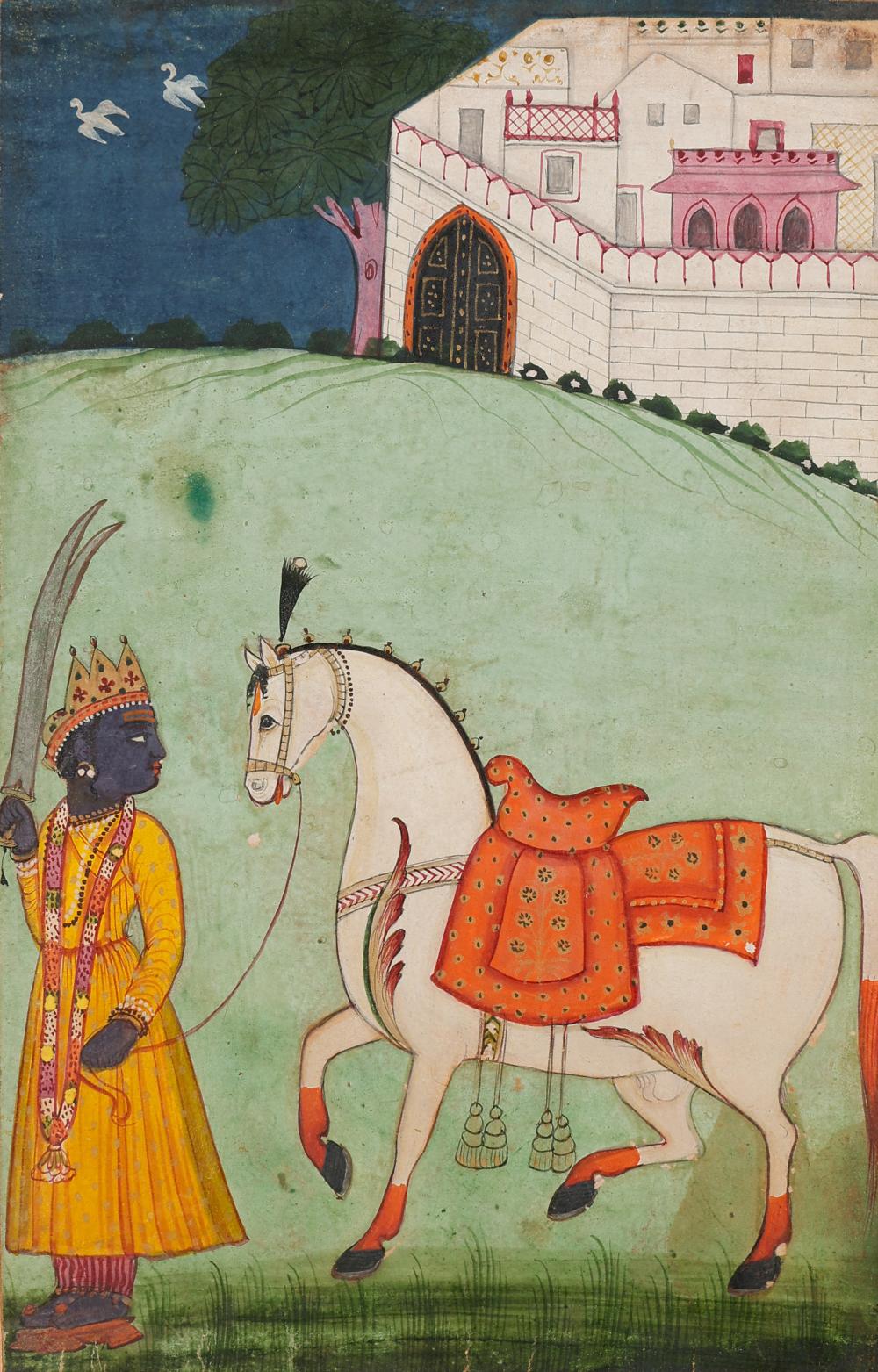
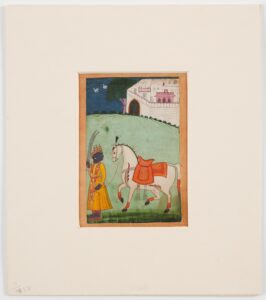
A finely executed Rajasthani miniature depicting Kalki, the tenth and future avatar of Vishnu, shown in the serene, courtly idiom characteristic of the Jaipur atelier. Kalki stands beside his mount, the white horse Devadatta, holding a curved sword and wearing a tall jeweled crown and yellow robe. His dark blue complexion identifies him unmistakably with Vishnu.
The composition is set against a deep ultramarine sky with two white birds in flight, above a stylized palace rendered in the distinctive architectural vocabulary of Jaipur: whitewashed walls, pink balconies, and a dark arched gateway framed by greenery. The bright, opaque pigments and crisp linework reflect the late‑19th‑century Jaipur palette.
Iconography
Kalki is identified through the combination of:
- Dark blue Vishnu‑skin
- Crown and royal ornaments
- Curved sword (symbol of purification and the end of the age)
- White horse Devadatta, his canonical mount
Unlike South Indian bronzes, which emphasize Kalki’s apocalyptic role through dynamic battle scenes, Jaipur painters often present avatars in idealized, contemplative stillness. Here, Kalki appears as a sovereign presence rather than a warrior in motion — a philosophical interpretation aligned with Vaishnava devotional aesthetics.
Attribution and Dating
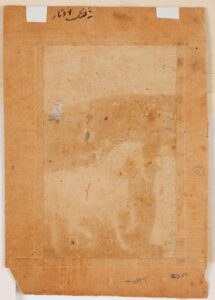
Despite a later Bengali inscription on the verso, the painting itself is stylistically and iconographically Rajasthani, not Bengali. The architectural forms, palette, figure proportions, and border treatment all point to Jaipur or late‑Mewar workshops. The pigment handling and simplified architectural rendering suggest a date between 1850 and 1920.
Provenance
Ex‑collection of P. O. Cheryan, Chevy Chase, Maryland. Cheryan was part of a mid‑20th‑century generation of Indian art collectors who acquired works directly in India during the 1950s–1970s. His collection frequently included Rajasthani and Pahari miniatures, often preserved with original dealer inscriptions on the verso. The Bengali notation likely reflects a dealer or collector’s mark from this period rather than the painting’s origin.
Acquired at auction in 2026. Estimate: $600–$900. Hammer price: $350 (total $455 with premium).
Significance
This miniature holds particular resonance for the collector, whose Spiritual Teacher invoked the name “Da Kalki” in His own revelation. The collector also spends time annually in Jaipur, home to one of India’s few historic Kalki temples, founded by Maharaja Sawai Jai Singh II in the early 18th century. The painting’s Jaipur origin thus aligns with both personal geography and spiritual lineage.
As Kalki iconography is relatively rare in miniature painting — especially in older works — this example represents a meaningful convergence of devotion, connoisseurship, and personal history.
the auction catalog, Material Culture in Philadephia, Arts of India auction of June 9, 2026
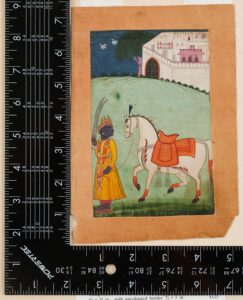
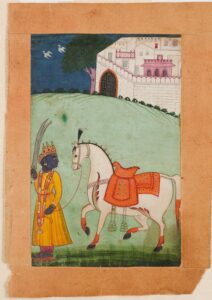
Bengal Miniature Painitng Of The Kalki Avatar Of Vishnu With Horse, Mid-Late 18th C. Opaque watercolor on paper. “Kalki avatara. (The White Horse). A white stallion with wings is led by Krishna holding a double-pointed sword. Eau-de-nil background with city and trees.” Verso Persian Rough Translation: “Bengal”. On mat. Size: 7.25” x 5.25”, 18 x 13 cm (sheet); 11.5” x 10”, 29 x 25 cm (mat). Provenance: ex collection of Mr. P.O. Cheryan, Chevy Chase, MD.
So this is dated earlier and as mid-18th century and said to be from Bengal, whereas Ai says 1850-1920 and from Jaipur
Description
Leave a Reply