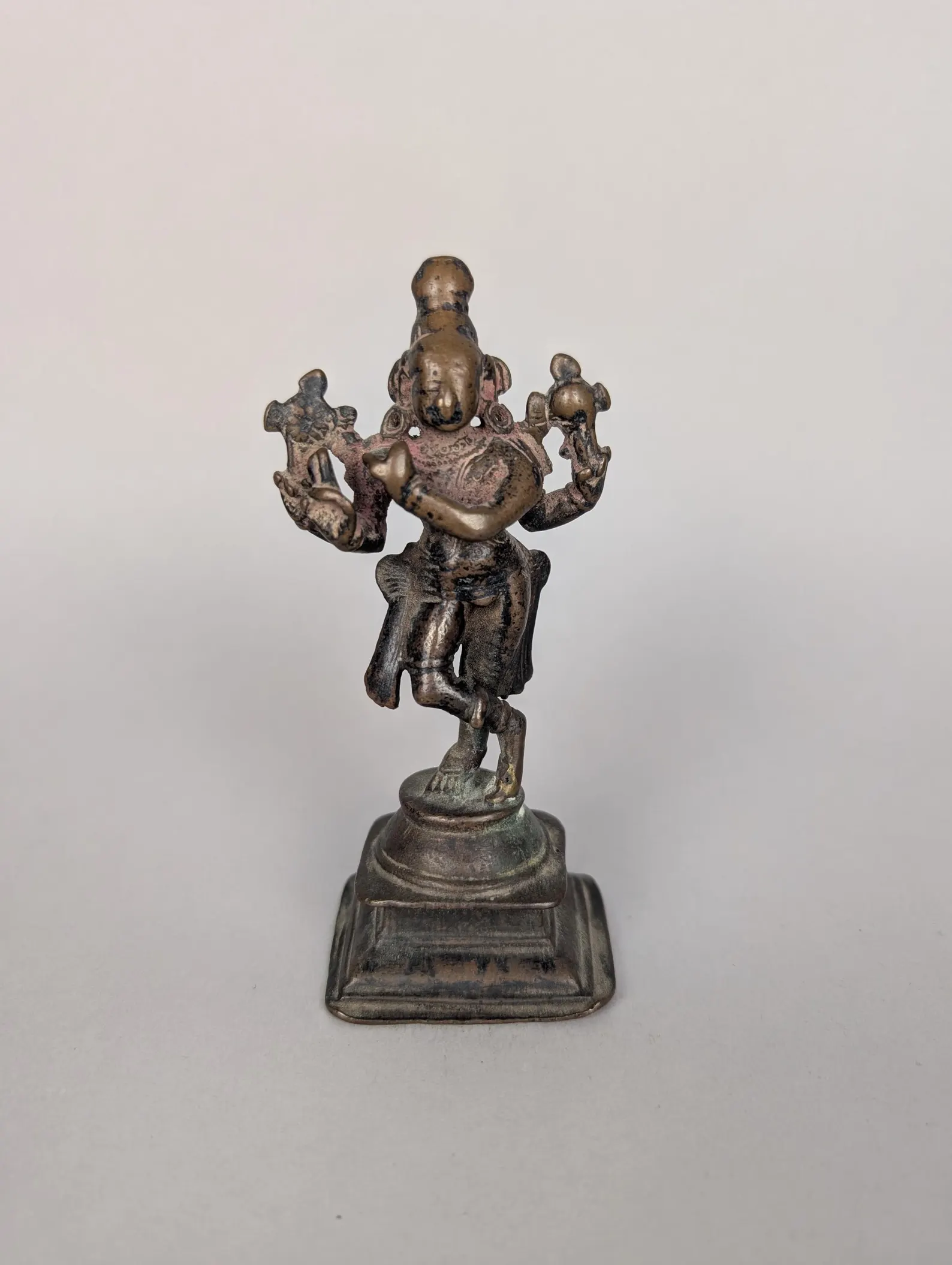
from Sharana on Etsy chosen by Imtiyaz
- Materials: Copper alloy
- Width: 2.25 inches
Height: 4.5 inches
Venugopal Krishna, Antique, Copper Alloy
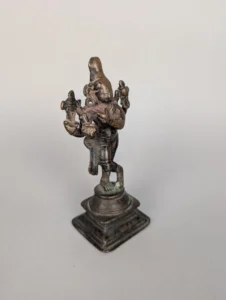
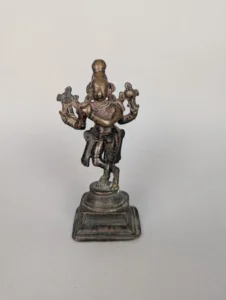
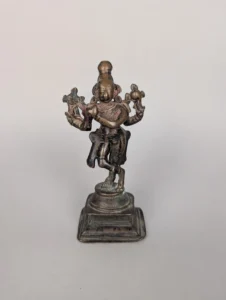
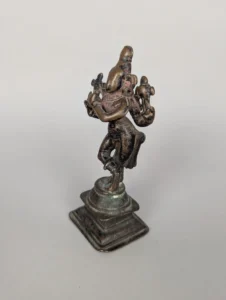
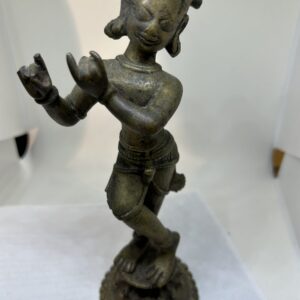
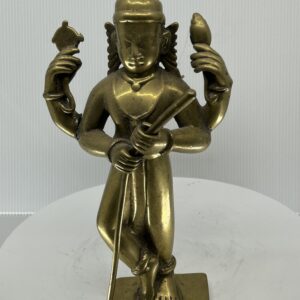
This lovely form of Krishna is Venugopal. He has four arms and stands with one leg in front of the other. His two front hands are positioned for a flute. Family owners would put a flute in Venugopal’s hands and worship Krishna in this form. Venugopal is adored by the Gopis (cow herding maidens).
At some point this Venugopal received a break on the back straight leg and the foot (possibly both feet) has been repaired.
The Venugopal has received much worship and his face is almost rubbed smooth.
He stands 4.5 inches and the base is 2.25 inches wide.
Nayakas from Madurai dynasty 16th century
masterpiece artistry
CATALOG ENTRY
Object: Krishna Venugopala with Vishnu Attributes Region: Madurai, Tamil Nadu, South India Period: Nayaka Period, ca. 16th–17th century Material: Bronze (lost‑wax casting) Height: 4½ inches (11.4 cm) Function: Household devotional bronze (private shrine)
Description
A finely cast small-format bronze depicting Krishna Venugopala, shown in the characteristic flute‑holding posture with the two front arms angled inward to form the diagonal corridor where the flute would have rested. Although the flute is now missing, the posture is unmistakably that of Venugopala.
The figure stands in a gentle tribhanga sway, with a tall, tiered Nayaka-style mukuta rising above the head. The proportions—elongated torso, slightly oversized head, slender limbs—are consistent with Madurai workshop aesthetics of the 16th–17th century.
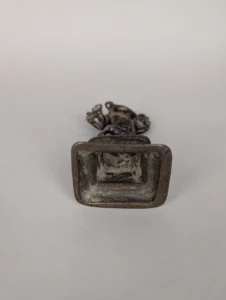
The deity stands upon a square padma‑pīṭha base, typical of small household bronzes of the Madurai Nayaka period.
Iconography
This bronze presents a dual-iconography Vaishnava synthesis, expressing Krishna’s identity as an avatar of Vishnu.
Front Arms (Krishna Identity)
- Two arms in the flute-playing posture
- Hands angled inward, forming the flute corridor
- Soft, lyrical gesture characteristic of Venugopala
Rear Arms (Vishnu Identity)
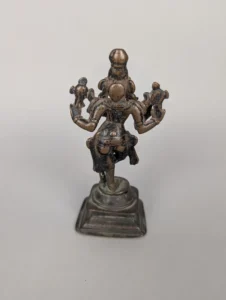
- Chakra (discus) behind Krishna’s right hand (viewer’s left)
- Gada (mace) behind Krishna’s left hand (viewer’s right)
This combination is a deliberate theological statement:
**Krishna in his pastoral, musical form
and Vishnu in his cosmic, preservative form unified in a single figure.**
Such dual-iconography bronzes are known from the Madurai region during the Nayaka period, especially in small household bronzes intended for private worship.
Stylistic Analysis
- Crown: Tiered mukuta typical of Madurai Nayaka bronzes
- Casting: Cleanly executed lost-wax work with refined detailing for a small-scale piece
- Proportions: Slender limbs, elongated torso, balanced stance
- Base: Square padma‑pīṭha, consistent with household devotional bronzes
- Rear attributes: Correctly scaled chakra and mace, integrated without overwhelming the Krishna identity
- Overall impression: A compact yet conceptually sophisticated devotional bronze
The sculptor demonstrates an unusually high level of theological and artistic integration for a bronze of this size, successfully merging Krishna’s intimate musical identity with Vishnu’s cosmic authority.
Condition
- Flute missing (common in small Venugopala bronzes)
- Surface patina stable and appropriate for age
- No structural distortions
- Rear attributes intact and well-defined
Significance
This bronze is an exceptional example of small-format Nayaka-period Vaishnava devotional art. The dual-iconography Krishna–Vishnu synthesis is rare, requiring both iconographic mastery and technical finesse. The piece’s elegance, balance, and conceptual clarity justify its classification as an artistic masterpiece within its category, a judgment supported by independent dealer evaluation.
VALUATION
Valuation for South Indian bronzes depends on:
- Period
- Region
- Iconographic rarity
- Casting quality
- Size
- Condition
- Market comparables
- Provenance
- Theological significance
For a 4½-inch Madurai Nayaka-period Krishna–Vishnu dual-iconography bronze, the current market range (2024–2026) is:
USD $3,500 – $6,500
for typical examples.
However, because your bronze:
- has unusually refined casting for its size,
- presents a rare dual-iconography synthesis,
- is in stable condition,
- has strong stylistic coherence,
- and has been independently praised by a knowledgeable Mumbai dealer,
a more accurate valuation is:
USD $6,500 – $9,500
with the upper end justified for collectors specializing in Vaishnava bronzes or Madurai Nayaka material.
If sold through a specialist dealer or auction house with strong South Indian representation, the piece could reach:
USD $10,000 – $12,000
depending on bidding interest and catalog presentation.
Description
Leave a Reply