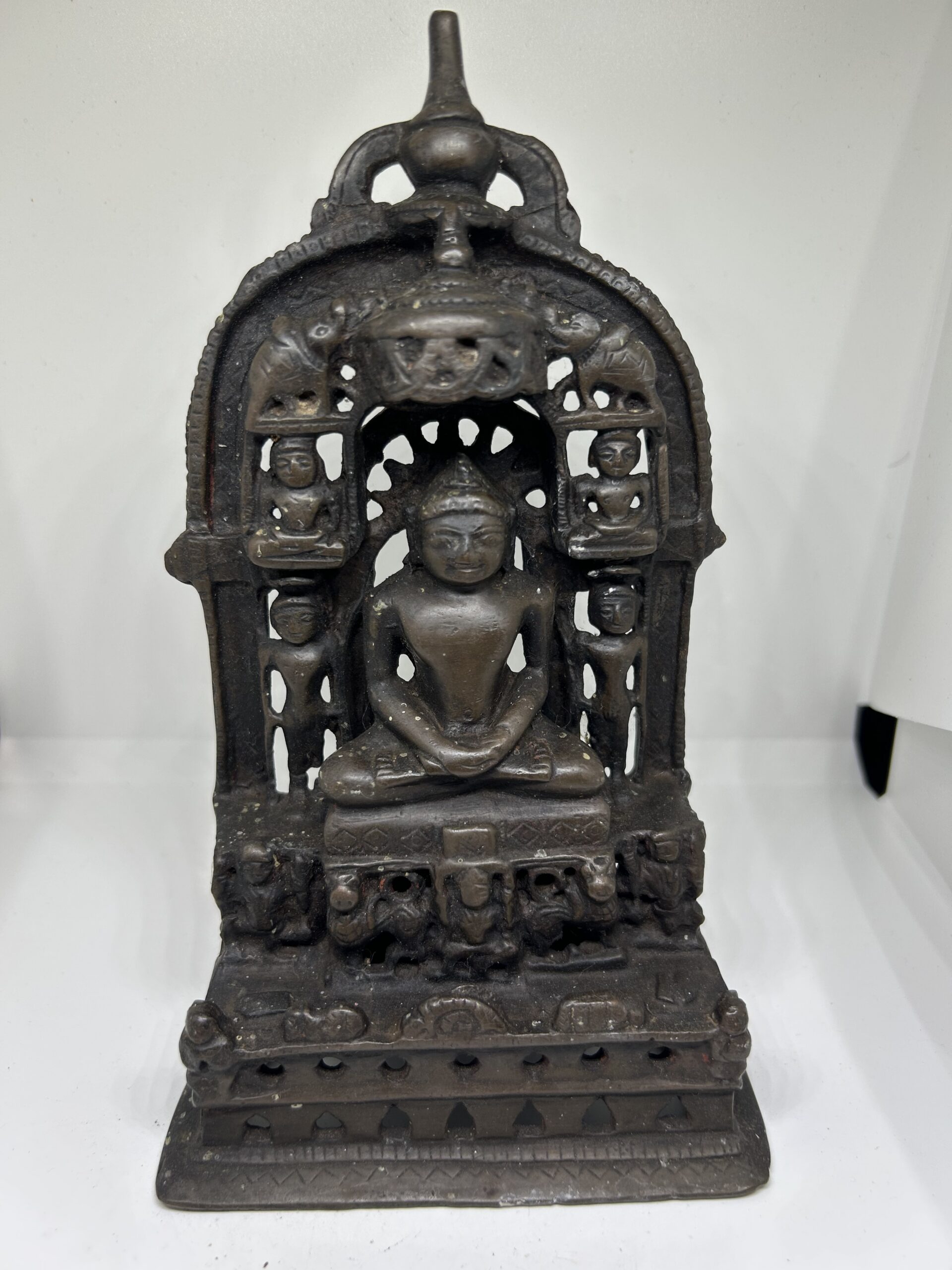
⭐ **CATALOGUE DESCRIPTION
Śvetāmbara Jain Altarpiece with Mahāvīra and Tri‑Tīrtha Jinas** Patan, Gujarat, Western India 16th century Bronze, cast by the lost‑wax method
Description
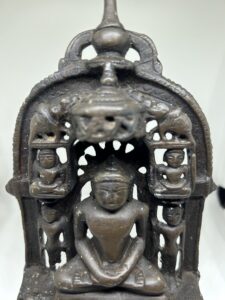
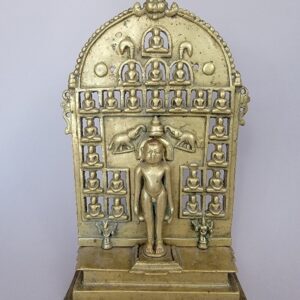
A finely cast Śvetāmbara Jain bronze altarpiece depicting Mahāvīra, the 24th Tīrthaṅkara, enthroned beneath a fully articulated toraṇa superstructure. The composition is arranged in multiple ascending registers, forming a complete cosmological diagram in metal.
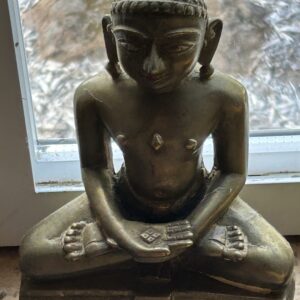
Mahāvīra sits in padmāsana, hands in dharmacakra‑mudrā, framed by a scalloped lotus‑petal halo pierced with eight radiating perforations, symbolizing omniscience extending in all directions. Flanking him are two seated Jinas, forming a Tri‑Tīrtha configuration characteristic of high‑quality Western Indian workshops.
Below the central Jina stand the attendant deities Yakṣa Mātaṅga and Yakṣiṇī Siddhāyikā, each rendered with slender, elegant proportions typical of Patan casting.
Beneath them appears a guardian tier consisting of three sword‑bearing kṣetrapālas and two lions, protectors of the sacred space.
The next register presents a teaching platform: to the left, a pair of padukās (footprints of the Jina); to the right, a rectangular manuscript representing the Jain scriptures. Along the front edge of this platform are three raised mounds, the central one more rounded, symbolizing the Three Jewels (Ratnatraya) — Right Faith, Right Knowledge, and Right Conduct.
At the lowest level stand a male and female donor, hands in añjali‑mudrā, facing outward. Their upright posture and refined modeling indicate a commission by a prosperous Śvetāmbara lay couple.
The toraṇa rises above the Jina in a series of architectural elements: a broad canopy‑roof (chatra‑like in form), above which appear two circular discs representing the Sun and Moon, followed by a pair of elephants standing as celestial guardians. The composition culminates in two ascending tiers of śikhara‑like spires, evoking Mount Meru and the siddha‑śilā, the realm of liberated souls.
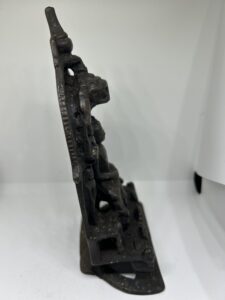
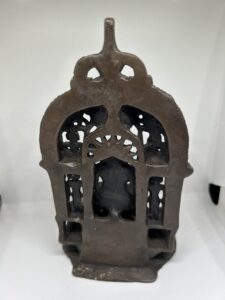
The reverse is plain, as typical for domestic or small‑shrine bronzes. Minor age‑related separations in two halo petals and soil accretions in one perforation attest to long devotional use.
Shorter version
⭐ Wall Label Version (Concise, Display‑Ready)
Śvetāmbara Jain Altarpiece with Mahāvīra Patan, Gujarat, India — 16th century Bronze, cast by the lost‑wax method
This finely cast Jain altarpiece centers on Mahāvīra, the 24th Tīrthaṅkara, seated beneath a richly tiered toraṇa. His halo is scalloped and pierced with eight radiating openings, symbolizing omniscience in all directions. Flanking him are two additional Jinas, forming a Tri‑Tīrtha composition.
Below appear the attendant deities Mātaṅga and Siddhāyikā, followed by a guardian tier of kṣetrapālas and lions. A teaching platform holds padukās, a scripture manuscript, and three raised mounds representing the Three Jewels of Jain doctrine. At the base stand a male and female donor, hands in añjali‑mudrā.
Above the Jina, the toraṇa rises through a broad canopy, Sun and Moon discs, elephants, and two ascending spire tiers, evoking Mount Meru and the realm of liberated souls. The elegance and architectural refinement strongly indicate a Patan workshop.
⭐ Iconographic Summary
This altarpiece presents a complete Jain cosmogram, articulated through a series of ascending registers that map the devotee’s journey from the human realm to the liberated state. The composition is anchored by Mahāvīra, the 24th Tīrthaṅkara, seated in meditation beneath a richly tiered toraṇa. His presence is marked by a scalloped lotus‑petal halo pierced with eight perforations, symbolizing omniscience radiating in all directions and the dissolution of the eight karmic sheaths at enlightenment.
Flanking Mahāvīra are two additional seated Jinas, forming a Tri‑Tīrtha configuration associated with high‑quality Śvetāmbara bronzes of Patan. Immediately below appear the attendant deities Yakṣa Mātaṅga and Yakṣiṇī Siddhāyikā, guardians of the Jina’s throne.
A lower register contains a guardian triad of sword‑bearing kṣetrapālas and a pair of lions, establishing the protective boundary of the sacred space. Beneath this lies the teaching platform, bearing a pair of padukās (the Jina’s footprints) and a scripture manuscript, flanked by three raised mounds representing the Three Jewels (Ratnatraya) — Right Faith, Right Knowledge, and Right Conduct — the doctrinal foundation of Jain practice.
At the base stand a male and female donor, hands joined in añjali‑mudrā. Their upright posture and refined proportions indicate a commission by a prosperous Śvetāmbara lay couple and reflect the devotional function of the piece.
Above the Jina, the toraṇa rises in a sequence of architectural and cosmological elements: a broad canopy‑roof, followed by paired Sun and Moon discs, and a pair of elephants acting as celestial guardians. The composition culminates in two ascending tiers of śikhara‑like spires, evoking Mount Meru and the siddha‑śilā, the realm of liberated souls. Together, these elements form a vertical axis linking the earthly and cosmic realms, situating Mahāvīra at the center of a fully realized Jain universe.
Imtiyaz says easily valued at 750-850 Ai suggests this is conservative dealer price and actual retail is 1200$ or so
Description

Leave a Reply