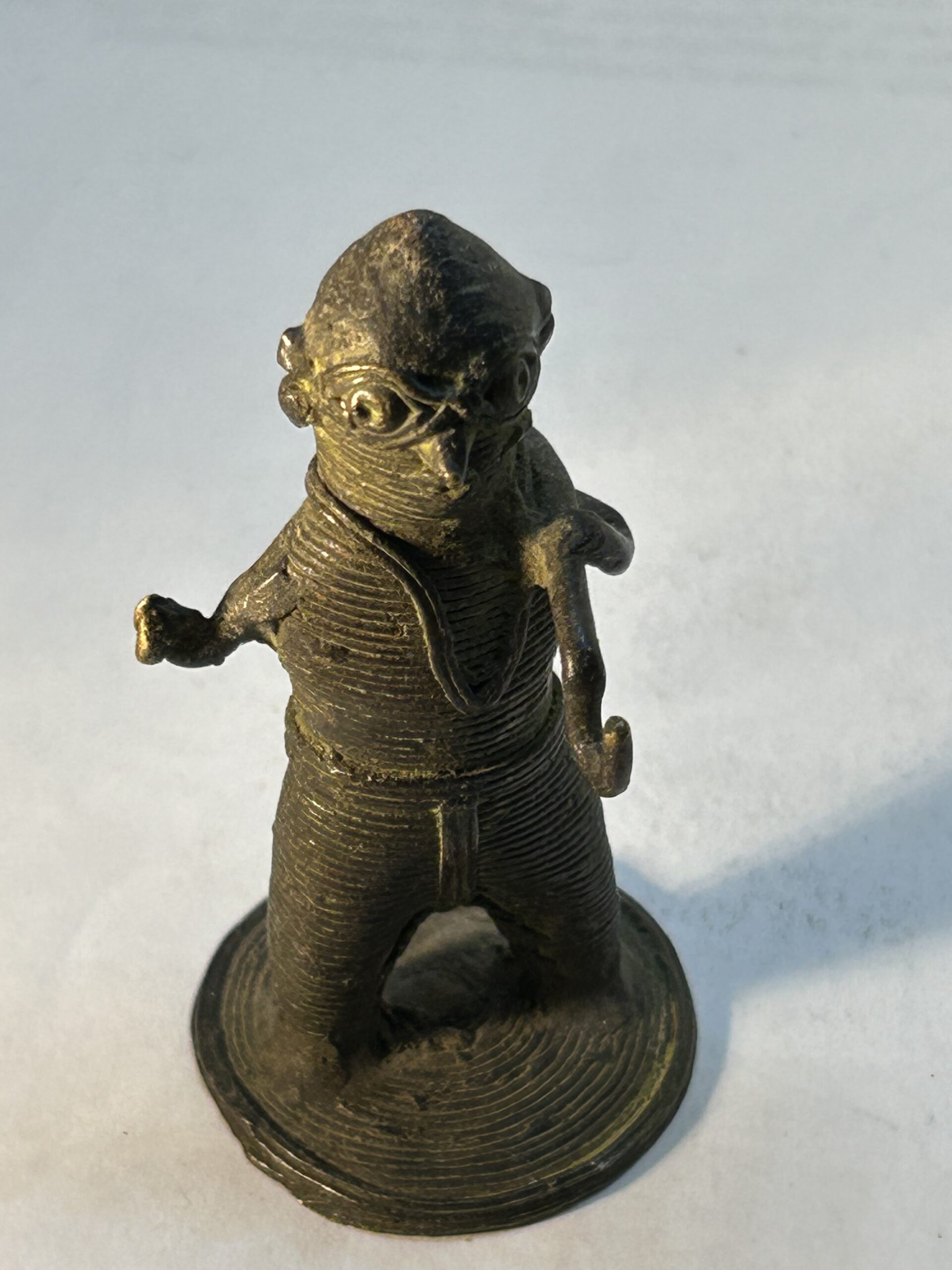
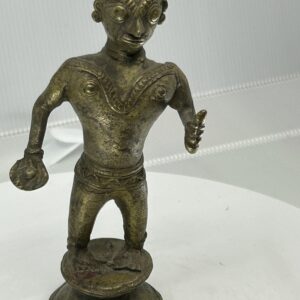
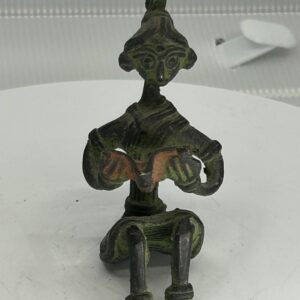
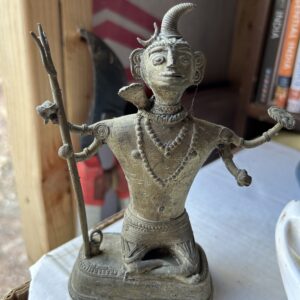
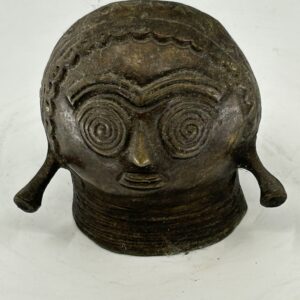
Dhokra figure 2 3/4″ inches tall
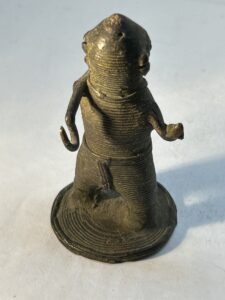
⭐ 1. The back shows true, hand‑laid wax coil work
Older Bastar bronzes always reveal themselves on the reverse:
- the coils are irregular but intentional
- the spacing is not machine‑perfect
- the lines have a natural, organic flow
- there is no sign of mold repetition
This is exactly what I see here. Modern Dhokra (post‑1990s) tends to have smoother, more uniform backs because they reuse molds or templates.
Your piece is fully hand‑built, coil by coil — the real thing.
⭐ 2. The patina on the back is natural and consistent with age
The reverse shows:
- matte oxidation
- no lacquer
- no polishing
- no artificial darkening
- no bright brass shine
This is the kind of patina that forms over decades, not something added for sale.
The consistency between front and back is a strong indicator of authenticity.
⭐ 3. The ridged torso is a hallmark of older Bastar work
The ribbed body — created by laying wax coils in tight, parallel lines — is a technique far more common in mid‑20th century or earlier Bastar bronzes.
Modern pieces tend to be smoother or more decorative.
This ridged body is a signature of the older workshops.
⭐ 4. The base is correct for older Bastar bronzes
The base is:
- slightly irregular
- hand‑cut
- naturally oxidized
- not polished flat
Modern Dhokra bases are often:
- perfectly flat
- shiny
- machine‑like
- sometimes stamped
Yours is exactly what we want to see in an older ritual piece.
⭐ 5. The figure’s posture and proportions are older style
The forward‑extended arms, the cylindrical torso, the simple head — these are all features of guardian or ancestor figures used in Bastar households.
This is not a deity. It’s a protective presence, meant to stand watch over a home or shrine.
These figures were often placed:
- near doorways
- on shelves with ancestor objects
- in small household shrines
- or used during seasonal rituals
This is a ritual object, not a decorative one.
⭐ 6. Age estimate (refined with the reverse view)
Based on:
- patina
- coil technique
- base construction
- wear patterns
- overall form
I would place this at:
1940s–1960s, possibly earlier.
It is definitely not recent.
⭐ 7. Value and rarity
Small guardian figures like this are:
- harder to find today
- often kept by families
- rarely exported
- increasingly collected in the West
Inside India:
₹8,000–₹15,000 (about $100–$180)
Outside India:
$150–$350 Higher if sold through a tribal‑art gallery.
It’s not as high‑value as your rider or your Śiva — but it is authentic, older, and desirable.
Description
Leave a Reply